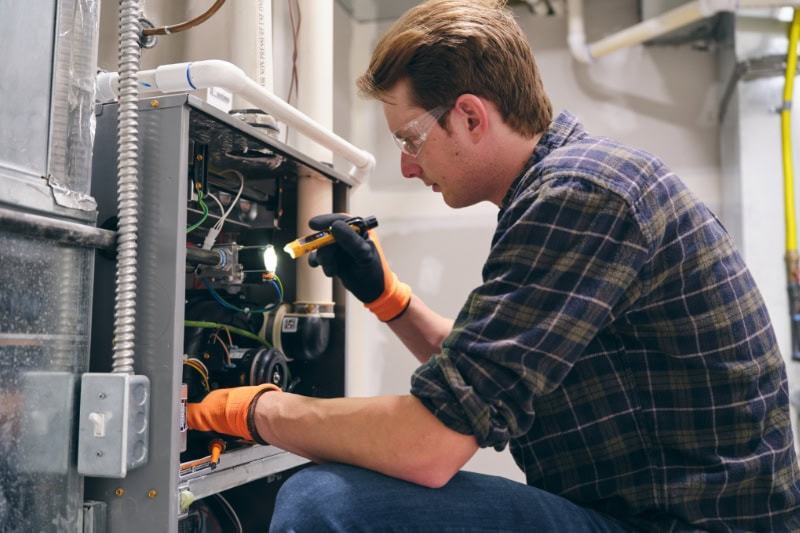
Furnaces talk. Most homeowners only learn the language at 11 PM when the thing starts banging like someone's trapped inside the ductwork. After thousands of noise calls across Aurora, here's the translation guide — what each sound usually means, how urgent it is, and what to do before you call. One rule first: a new, loud noise that wasn't there last week is always worth a call. Furnaces don't develop new sounds for fun.
On this page
Banging or booming at startup: delayed ignition
The classic: the furnace kicks on with a whump or a full bang that rattles the ducts. This is usually delayed ignition — gas builds up for a second or two before the burners light, and the accumulated gas ignites all at once.
Cause is almost always dirty or misaligned burners, or a weak ignitor that's slow to light the gas. It's not just annoying: repeated small explosions stress the heat exchanger, and a cracked heat exchanger is a carbon-monoxide risk. Urgency: schedule within days, not weeks. The fix is usually a burner cleaning and ignitor check — one of the cheaper service calls we do.
Howling or whistling: airflow problems
A steady howl or high whistle while the furnace runs is an airflow sound, not a mechanical failure — usually. Common causes: a clogged filter choking the return (check this first, seriously), undersized or crushed return ducting, or a blower running at the wrong speed.
The 30-second homeowner test: pull the filter out and run the furnace for one cycle. If the howl stops, you found it — replace the filter and don't run filterless longer than the test. If it keeps howling with no filter, the restriction is in the ductwork and that's a tech visit. Not an emergency, but restricted airflow overheats heat exchangers over time, so don't ignore it all winter.
Rattling or vibrating: something's loose
Rattling that changes when you press on the furnace panels is usually just loose access panels or a loose duct connection — tighten the panel screws and see. Rattling from inside the cabinet is different: a cracked blower wheel, a failing blower motor mount, or (on older units) a heat exchanger panel starting to separate.
The panel test takes ten seconds and fixes half of rattle calls. The other half need a tech, because a blower wheel coming apart at speed can take the motor with it, and that turns a moderate repair into an expensive one.
Clicking: normal vs. not normal
Some clicking is normal — the gas valve opening, relays pulling in, ducts expanding as they heat (the “ticking” radiators of forced air). What's not normal: rapid repeated clicking with no ignition (the furnace trying and failing to light — bad ignitor or flame sensor), or a loud single clunk from the blower area on every startup (failing capacitor or motor).
Count the pattern: click… whoosh = normal. Click-click-click-click… silence… click-click-click = call us. That furnace is telling you the ignition sequence is failing.
Humming or buzzing: electrical
A low hum from the furnace cabinet is usually the transformer — normal in small doses. A loud buzz, especially one you can hear from the next room, points to a failing capacitor, a contactor chattering, or loose electrical connections arcing. Electrical buzzing is the one noise on this list I'd call urgent: arcing connections are a fire risk. Kill the furnace at the thermostat and the breaker, then call.
Scraping or metal-on-metal: shut it down
Scraping, screeching, or grinding from the blower compartment means metal is touching metal — typically blower wheel scraping the housing or motor bearings gone completely. Turn the furnace off. Running it grinds the wheel into the housing and converts a motor replacement into a motor-plus-housing job. This one can't wait for a convenient appointment.
How to record the sound for your tech (it helps enormously)
“It's making a noise” is the hardest service call to dispatch well — so help us help you:
- Record it. Phone video, 30 seconds, standing near the furnace. Capture 2–3 occurrences. The pattern (when in the cycle it happens) is diagnostic gold.
- Note the timing: at startup only? Throughout the run? At shutdown? Startup-only points to ignition; continuous points to blower/airflow; shutdown-only points to duct expansion or delayed gas valve closure.
- Note what changed: new filter? Recent work? First cold snap? Noises with a “before” are easier to solve than mysteries.
- Don't try to reproduce it repeatedly. Cycling a furnace with delayed ignition ten times for a better recording stresses the exchanger. Two or three captures is plenty.
Play the recording when you call. A tech who's heard your exact bang before you arrive brings the right parts — which is the difference between a one-trip fix and a diagnosis-plus-return.
Hearing something new from your furnace?
Describe the sound when you call — banging, howling, clicking — and we'll tell you straight whether it's urgent.
Frequently asked questions
My furnace bangs once when it starts but then runs fine. Is that okay?
No — that's textbook delayed ignition. It runs “fine” until the repeated mini-explosions crack the heat exchanger. Get the burners cleaned and the ignitor checked before heating season peaks.
Can I diagnose the noise myself?
You can do the filter test and the panel-press test above — both are safe and fix a surprising number of calls. Don't open the burner compartment or touch gas components; that's where DIY ends and a tech begins.
The ducts pop and tick when the heat comes on. Is that a problem?
Usually just thermal expansion — ducts flexing as they heat up. It's cosmetic unless the popping is new and violent, which can mean a pressure or airflow change worth checking during a tune-up.
How much does a noise diagnosis cost?
Our standard diagnostic fee ([TBD]) covers noise calls, waived if you approve the repair. Most noise fixes land in the cheaper half of our repair price ranges.
Is it safe to run the furnace until the tech arrives?
For most noises (rattling panels, howling airflow, clicking): yes, with the filter checked. For scraping/grinding or loud electrical buzzing: no — shut it down. For banging at startup: minimize cycles until the visit; each delayed ignition stresses the exchanger.
The noise stopped on its own. Do I still need a visit?
Yes — intermittent noises are still diagnostic information, and the underlying cause (dirty burners, weak ignitor, loose panel) hasn't fixed itself. Noises that “go away” usually come back at 2 AM. The recording you took while it was happening is still useful; bring it.
The bottom line: furnaces don't develop new sounds for fun — every noise on this list is a component telling you something, and the translation is usually simple. Do the safe homeowner checks (filter, panels), record the sound with timing notes, and call before it becomes the 2 AM version. A bang in October is a burner cleaning; a bang ignored is a cracked exchanger.
PROUDLY SERVING AURORA, CO 80010