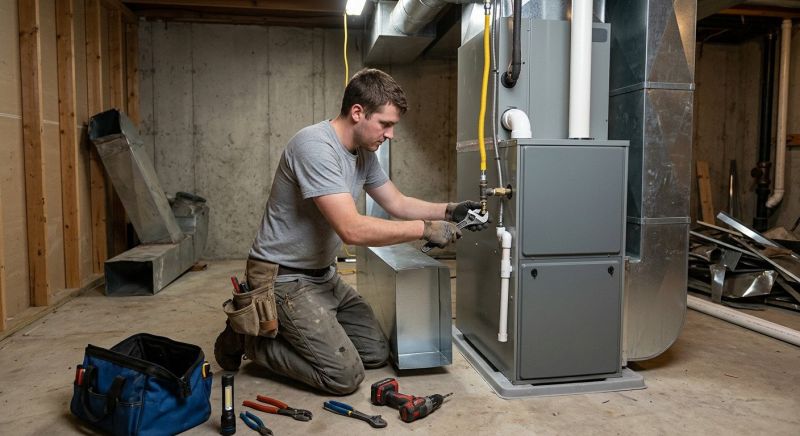
“I have a furnace… I would like to be checked for the winter.” We hear that call every October, usually within the first week the temperature drops into the 30s. And every fall, we walk into homes where a competitor charged for a “tune-up” that was, in reality, a filter swap and a handshake. So here is the full checklist our techs actually run on a PeakLine furnace tune-up in Aurora — all 21 points. Print it. Ask the next company that quotes you to match it.
On this page
What a tune-up actually is (and isn't)
A furnace tune-up is preventive maintenance, not a repair visit. The goal is simple: catch the small failure before it becomes the 2 AM no-heat call on the coldest Saturday of January. In Aurora's older housing stock — 1958–1973 builds in 80011, many on original or second-generation furnaces — a tune-up is also a safety inspection. Cracked heat exchangers and carbon monoxide do not announce themselves.
It is not a sales visit wearing a tool belt. If a tech spends 15 minutes and then tells you the whole system needs replacing, you got a sales pitch, not a tune-up. A real one takes 60–90 minutes on a standard gas furnace.
The 21-point checklist
Here is exactly what we check, in the order we check it. If your quote doesn't mention most of these, you're not buying a tune-up — you're buying a visit.
- Thermostat calibration and anticipator settings — verify the thermostat reads the true room temperature and cycles the furnace correctly.
- Filter inspection — check type, size, condition; replace if you have one on hand (we stock common sizes).
- Blower wheel and motor inspection — dirt on the blower wheel is the #1 silent efficiency killer we see.
- Blower motor amp draw test — measured against the motor's nameplate rating; high draw means failing bearings or a dying motor.
- Inducer motor operation — the small motor that clears exhaust gases before ignition. Noisy inducer = winter breakdown brewing.
- Ignitor inspection — hot-surface ignitors develop hairline cracks. We check resistance, not just “does it glow.”
- Flame sensor cleaning and microamp reading — a dirty flame sensor causes the classic “furnace starts, runs 30 seconds, shuts off” symptom.
- Burner assembly inspection and cleaning — rust, spider webs, and misaligned burners all change the flame picture.
- Flame pattern observation — blue and steady is correct; lazy yellow flame means combustion problems.
- Heat exchanger visual inspection — the most important safety item on the list. We look for cracks, rust-through, and separations.
- Carbon monoxide test at the supply registers — ambient CO readings inside the home; any reading above zero gets investigated.
- Flue pipe and venting inspection — proper slope, no sags, no disconnections, no bird nests (yes, really).
- Gas valve operation and manifold pressure — verify gas pressure matches the furnace's rating plate.
- Gas line leak check — electronic leak detection at every accessible joint.
- High-limit and safety controls test — the safeties that shut the furnace down before it overheats must actually work.
- Pressure switch tubing — cracked or waterlogged tubing causes intermittent shutdowns that are maddening to diagnose cold.
- Condensate drain (high-efficiency furnaces) — clear blockages; a clogged drain shuts the furnace down on pressure switches.
- Electrical connections and contactors — tighten and inspect for heat damage; loose connections cause control board failures.
- Capacitor test — weak capacitors are a top cause of blower motors that hum but won't start.
- Temperature rise measurement — supply vs. return air temperature compared against the furnace's rated range. Wrong rise = wrong airflow = cracked exchanger risk.
- Full cycle test and written report — run the furnace through a complete heat call and hand you the readings, not just “looks good.”
How long it takes and what disrupts it
Plan on 60–90 minutes for a standard gas furnace with reasonable access. Add 30 minutes if the furnace is in a cramped crawlspace, if it's a high-efficiency unit with condensate plumbing to clear, or if we find something that needs your decision mid-visit.
What actually slows a tune-up down: a furnace buried behind storage (clear a 3-foot working zone before we arrive — you will thank us), a dead thermostat battery we have to diagnose first, and discovering a cracked heat exchanger, which stops the tune-up and starts a safety conversation. That last one is the whole point of doing this in October instead of January.
How to spot a fake tune-up
Red flags from real Aurora stories:
- The tech is in and out in under 25 minutes. Physically impossible to do 21 points.
- No combustion readings or amp draws are written down or shown to you.
- The “tune-up” ends with a replacement quote but no specific failed part named.
- They never opened the burner compartment. We have seen this. Twice.
- The price was suspiciously low — the $49 tune-up is a door-opener for a sales visit, not a service.
A legitimate company will hand you the readings. Ask for them before the tech leaves. If they can't produce them, the tune-up didn't happen.
Anything under 25 minutes was a sales visit, not a service.
Why October in Aurora is non-negotiable
Colorado's first real cold snap usually lands in October, and every year it exposes the furnaces that were “fine” in September. Our emergency calls triple the week after the first sub-30°F night. A tune-up in October means the tech finds the weak ignitor, the cracked exchanger, the dying capacitor while the part is on a truck and the schedule has same-week openings.
In north Aurora specifically — 80011's 1960s ranches — we see a lot of furnaces in the 15–20 year range on their original heat exchangers. Those are exactly the units where a fall tune-up is a safety inspection in disguise. Carbon monoxide from a cracked exchanger is odorless; the furnace does not smell “wrong.” The detector you should have anyway (we'll say it again in our CO post) is your backup — the tune-up is your first line.
What a real tune-up should cost in Aurora
A genuine 21-point tune-up from a licensed company in Aurora runs [TBD] — that covers the full hour-plus visit, all readings, the filter if we stock your size, and the written report. Anyone quoting dramatically under that is skipping points. Anyone quoting dramatically over it is padding.
Compare it against the alternative: an emergency no-heat diagnostic in January plus the repair, which routinely totals 2–3× the tune-up cost — and that's if the part is available same-day. The math is not close.
Before the tech arrives: the 10-minute prep
Help us help you — ten minutes before the appointment:
- Clear a 3-foot working zone around the furnace. Move the storage, the holiday decorations, the “I'll deal with it later” pile.
- Make sure an adult who can authorize work is home — we'll find things that need your decision.
- Note any symptoms: weird sounds, cold rooms, the thermostat's quirks. Write them down; you'll forget half of them when asked.
- Know your filter size (printed on the frame) in case we don't stock your oddball size — we'll tell you what to buy.
- Unlock the gate / secure the pets. The tech needs the furnace, the thermostat, and every register — the dog's cooperation is appreciated but optional.
That's it. No cleaning the house, no staging. We've seen every basement in north Aurora; yours is fine.
Book your October tune-up before the cold snap
Same-week appointments in Aurora. The full 21-point checklist, written readings, no sales pitch.
Frequently asked questions
How often does my furnace need a tune-up?
Once a year, every fall, before heating season. If your furnace is over 12 years old or you skipped last year, do not skip this one — older heat exchangers need the annual safety check.
Do I need a tune-up if my furnace is working fine?
Yes — that is exactly when you want it. Tune-ups find the failing ignitor and the cracked exchanger while they are cheap, scheduled problems instead of expensive emergency ones.
Should I replace the filter before the tune-up?
You can, but you don't have to. We check the filter as point #2 and carry common sizes. If yours is a specialty size, tell us when you book and we'll bring one.
Will a tune-up void or protect my warranty?
Most manufacturer warranties require annual maintenance by a licensed tech. Our written report is your proof of compliance if you ever file a warranty claim.
What's the difference between a tune-up and a safety inspection?
A tune-up includes the safety checks (heat exchanger, CO, gas leaks) plus performance items (cleaning, calibration, efficiency readings). A dedicated safety inspection goes deeper on the safety side for older units and real-estate transactions.
PROUDLY SERVING AURORA, CO 80011