Nobody else in Aurora will write this post honestly, because most companies either only service swamp coolers or only install AC. We do both — we maintain evaporative coolers and we convert them — so we don't have a side. Here's the real comparison for an Aurora homeowner in 2026: what each system actually costs to run, where swamp coolers win, where they lose, and the math on converting.
On this page
How each one actually cools your house
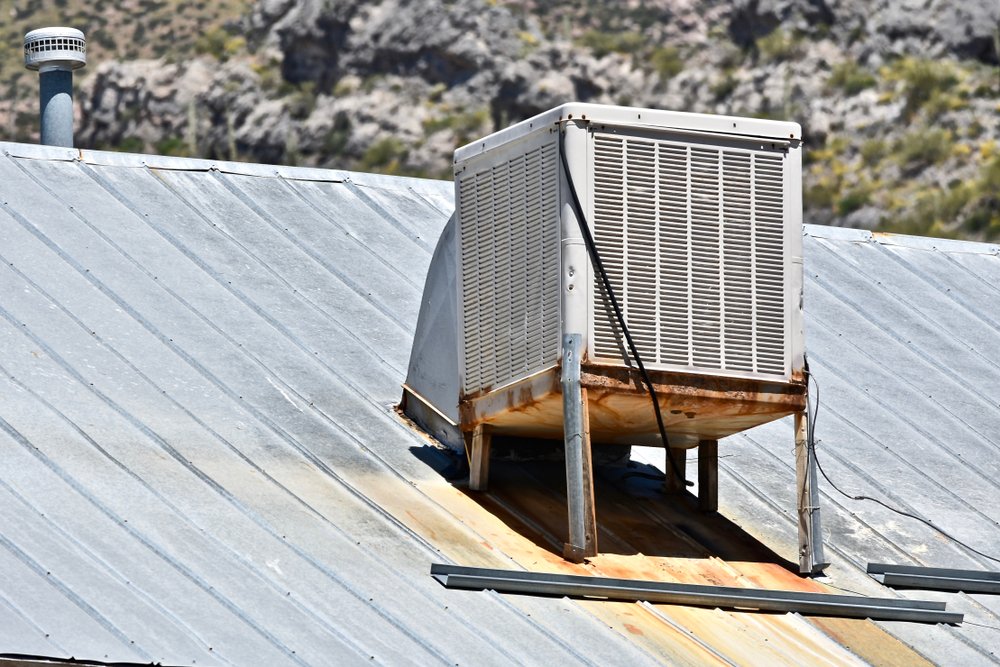
A swamp cooler (evaporative cooler) pulls hot dry outside air through water-soaked pads. Evaporation drops the air temperature 15–25°F and pushes that cooled, humidified air through your home — usually through the same ductwork your furnace uses, or through a central ceiling/window discharge. It works because Colorado air is dry; the drier the air, the bigger the temperature drop.
Central AC is a refrigeration cycle: the outdoor condenser compresses refrigerant, the indoor coil gets cold, and the blower pushes house air across it. It doesn't care about humidity — it cools and dehumidifies, which is why AC air feels crisper.
The key difference for Aurora: a swamp cooler adds moisture to your home (nice in our dry climate, up to a point), while AC removes it. On a 95°F July day with 15% humidity, a well-maintained swamp cooler delivers 70–75°F air. On a 95°F day during monsoon season when humidity spikes to 40%+, that same cooler might only manage 82°F — and now your house is humid and warm.
Comfort: the honest scorecard
Swamp cooler wins: mild days (under 90°F), dry days, and anyone who likes fresh-air feel — coolers constantly bring in outside air, so the house never gets that sealed-box staleness. Operating cost is dramatically lower (see below). And in dry heat, the added humidity feels good on skin and sinuses.
Central AC wins: every day over ~93°F, every humid stretch, and temperature control — AC holds a setpoint; a swamp cooler drifts with the weather. Bedrooms at night: AC wins decisively. Anyone with allergies: AC wins, because the house stays closed and filtered instead of pulling in pollen and wildfire smoke through wet pads. (2026's smoke season settled that debate for a lot of our customers.)
The uncomfortable truth: a swamp cooler is a good-weather cooling system in a climate whose summers are getting hotter and smokier. It was the right answer for 1985 Aurora. For 2026 Aurora, it's the right answer only on the right days.
Operating costs: water, electricity, maintenance
Electricity: a swamp cooler is basically a big fan and a small pump — roughly 400–700 watts. Central AC's condenser + blower runs 2,500–4,000 watts. Per hour of cooling, the swamp cooler costs roughly a fifth of AC in electricity. This is the cooler's biggest honest advantage and it's real.
Water: a residential swamp cooler uses 3–10 gallons per hour of operation. Over an Aurora summer that's thousands of gallons — and Aurora water rates have been climbing. It's still cheaper than the electricity delta in most cases, but it's not free, and it's worth doing your own math with your actual water bill.
Maintenance: swamp coolers need seasonal pad replacement, winterization (drain and cover), and de-winterization every spring — plus mid-summer pad checks when the air starts smelling musty. Skip it and efficiency tanks. Central AC needs an annual tune-up and a filter schedule. Roughly comparable effort, but cooler maintenance is messier and more frequent.
The part nobody mentions: home value and sellability
Here's the market reality in Aurora: buyers under 40 expect central AC. A home with only a swamp cooler appraises the same but sells slower and draws lower offers in summer listings — we've heard it from local agents repeatedly. If you're selling within 5 years, conversion isn't just comfort, it's resale math.
Renters are even blunter: “does it have AC?” is a top-3 rental listing question. Landlords with swamp-cooler-only properties in 80011 compete at a discount against AC units on the same street.
The honest verdict
Keep the swamp cooler if: it's under 10 years old, well-maintained, your house stays comfortable through July, and you're not selling soon. We'll happily maintain it — that's a real service we offer.
Convert to central AC if: you're miserable for 3+ weeks every summer, monsoon humidity defeats the cooler, wildfire smoke season keeps you sealed inside anyway, you're selling in the next few years, or the cooler needs a major repair (a $1,500+ cooler rebuild on a 12-year-old unit is money toward conversion, not away from it).
The hybrid some homeowners choose: keep the cooler for shoulder season, add a mini-split for the bedroom. It's the cheapest path to sleeping cool in August — see our mini-split guide.
The environmental angle: water vs. electricity
Colorado's the headwaters state, so the resource question matters here beyond the bill. A swamp cooler trades electricity for water — roughly 3,000–8,000 gallons per cooling season for a typical home. Central AC trades water for electricity — zero water, but 4–5× the watts.
Which is “greener” in Aurora? It depends on the grid and the drought. In a dry year with reservoir levels dropping, the AC's zero-water profile is a genuine civic plus. On electricity sourced increasingly from renewables, the carbon math favors... it's genuinely close, and anyone claiming certainty is selling something. Our take: pick based on comfort and cost, and let the environmental tiebreaker go to AC in drought years — one less straw in the Colorado River.
One concrete tip either way: if you keep the cooler, a bleed-off management setup (or a modern controller) cuts water waste significantly versus the old continuous-bleed systems. Ask during your spring service — it's a cheap upgrade that pays back in one season.
Wondering what conversion costs for your house?
Free in-home conversion assessment: duct check, electrical check, and a written quote with real numbers.
Frequently asked questions
Can my existing furnace ducts handle central AC?
Usually yes — that's the good news. Most 80011 homes already move cooler air through the furnace ductwork, and AC uses the same ducts with an evaporator coil added at the furnace. We verify duct sizing and condition during the conversion estimate.
How long does a swamp-cooler-to-AC conversion take?
Typically 1–2 days: set the condenser, install the coil and refrigerant lines, wire the electrical, and commission the system. No duct replacement in most cases.
Will my electric bill spike after converting?
It will rise — AC uses more electricity, period. Most Aurora homeowners see summer electric bills roughly double versus cooler-only, while gaining precise temperature control. Our conversion estimates include an honest operating-cost projection.
Do you repair swamp coolers, or only convert them?
Both. We service the installed base — pads, pumps, motors, winterization — because a working cooler is fine for many homes. Conversion is for when it's not.
Is a swamp cooler better for Colorado's dry air?
It's nicer-feeling air on dry days — the added humidity is genuinely pleasant. But “dry air” problems (static, dry skin, wood floors) are better solved with a whole-home humidifier on a furnace + AC combo than by relying on a cooler.
Can I run both — cooler in spring, AC in summer?
You can, but nobody does for long — maintaining two cooling systems doubles the upkeep for little benefit. Pick the primary; if that's AC, the cooler becomes a very heavy paperweight.
PROUDLY SERVING AURORA, CO 80011